
Concrete Driveway & Sidewalk Specifications for Michigan
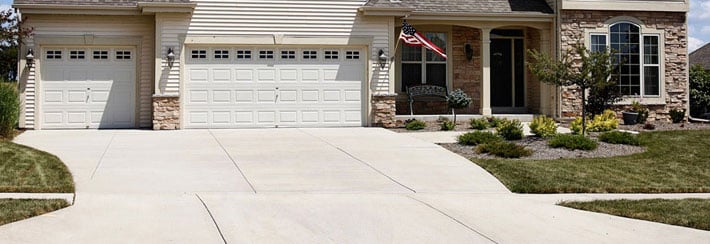
These are the Michigan Concrete Association's design and placement requirements for residential and light-duty concrete flatwork — driveways, sidewalks and approaches. They reflect MCA's 2025 MI-Concrete Driveway and Sidewalk Guidelines and apply across Michigan, which is classified as a severe weathering region. A driveway built to a warm-climate specification will not last here.
Specifiers, contractors and homeowners can all work from this page. Where a local agency or municipality publishes its own requirements, those govern — check with the authority having jurisdiction before placing.
Michigan Driveway and Sidewalk Specifications at a Glance
| Requirement | MCA Specification |
|---|---|
| Minimum thickness | 4 inches; 5 inches where traffic includes delivery vehicles |
| Compressive strength (f’c) | 4,000 psi minimum at 28 days |
| Air content | 6.5% ± 1.5% total, by volume |
| Water/cementitious ratio | 0.45 maximum, in place |
| Slump at point of placement | 4 inches maximum; up to 7 inches with a mid- or high-range water reducer |
| Cementitious content | 564 lbs minimum recommended |
| Sub-base | 4 inches minimum, compacted |
| Drainage slope | 1/8 inch per foot minimum (1–2%), drained to daylight |
| Control joint spacing | 2× the slab thickness — 8 ft for a 4-inch slab |
| Control joint depth | ¼ the slab thickness — 1 inch for a 4-inch slab |
| Curing | 7 days recommended; 2–3 days where strength testing confirms opening-to-traffic strength |
| Opening to traffic | After 7 days of curing, or sooner when testing confirms 3,000 psi |
Subgrade and Sub-base Preparation
Most driveway failures that look like concrete problems are subgrade problems. The slab can only be as uniform as what it sits on.
- The subgrade shall be free of organic and uncompacted material.
- Unstable material shall be removed to a minimum depth of 6 inches and replaced with crushed stone, gravel or sand, compacted to 95% maximum density.
- Sub-base material shall be a minimum of 4 inches thick, compacted.
- If the sub-base is dry, dampen it before concrete placement. No standing water shall be present when concrete is placed.
- In no case shall concrete be placed on a frozen subgrade or sub-base. As frozen ground thaws beneath a new slab, it settles unevenly and the concrete cracks to follow it.
Drainage
A minimum slope of 1/8 inch per foot (1–2%) shall be maintained, and the subgrade shall be drained to daylight or to a drainage system. Water that collects under a slab in Michigan will freeze under it.
Concrete Thickness
The minimum recommended thickness is 4 inches. Where traffic will include delivery vehicles, the minimum thickness is 5 inches. This is the requirement most often missed on residential work: a driveway that will see a loaded truck — deliveries, a dumpster, a concrete truck during a later project — needs the extra inch from the start. It cannot be added afterward.
Mix Design and Materials
Concrete properties
- Minimum specified compressive strength (f’c): 4,000 psi at 28 days.
- Maximum in-place water to cement or water to cementitious ratio: 0.45 or less.
- Maximum slump at the point of placement: 4 inches. This may be increased up to 7 inches by using a mid-range or high-range water-reducing admixture — not by adding water.
- Total air content by volume: 6.5% ± 1.5%. Entrained air is what gives freezing water somewhere to go inside the paste. Without it, Michigan freeze-thaw cycles will scale a slab no matter how well it was finished.
- Minimum recommended cementitious content: 564 lbs.
Materials
- Portland cement shall conform to ASTM C150 or ASTM C595.
- Aggregates shall conform to ASTM C33 class D (formerly 4S) or MDOT specifications for concrete aggregates. ASTM size #57 or #67, or MDOT size 6AA or 17A with MDOT 2NS, should be specified in the mix design.
- Slag cement shall conform to ASTM C989; coal ash (fly ash) shall conform to ASTM C618.
- Chemical admixtures shall conform to ASTM C494; air-entraining admixtures to ASTM C260.
Batching and delivery
- Concrete shall be batched, transported and discharged in accordance with ASTM C94.
- Any water added on site after delivery should be documented on the concrete delivery ticket. An undocumented water addition is the single easiest way to lose the strength and the air content the mix was designed for.
Placing and Finishing
MCA recommends that at least one MCA Certified Exterior Concrete Finisher be involved in the finishing. The ECF credential is Michigan-specific and includes a hands-on performance evaluation on an actual installation, so it tests placing and finishing in the field rather than knowledge alone. A certified ACI flatwork finisher also satisfies the 2025 guidelines. The recommended sequence is strike-off, bull floating, edging, curing, jointing and texturing.
- Do not perform finishing operations while bleed water is still visible.
- Do not use steel trowels, fresnos or other tools that may seal the surface prematurely. Sealing the surface traps bleed water beneath it and produces a weak, non-durable wearing course.
- Do not sprinkle water onto the surface — “blessing” the concrete — to aid finishing.
- Edge the concrete around the perimeter and at all tooled joints, maximum radius ½ inch.
- Apply a broomed texture using a stiff-bristle broom.
- Use of fly ash or slag cement will change the time of finishing. Plan the crew around it.
An evaporation retarder is highly recommended on low-humidity or windy days, and a finishing aid — either integral or topical — is beneficial with Type IL cements. See blended portland-limestone cement for how Type IL behaves differently on the job.
Jointing
Concrete will crack. Jointing decides where.
Control joints
- Install in both directions at intervals not exceeding two times the slab thickness — 8 feet for a 4-inch slab, 10 feet for a 5-inch slab.
- Panels should be as square as possible. In no case shall the ratio of length to width exceed 1.5 to 1. An 8 ft × 8 ft panel is the target for a 4-inch driveway.
- Minimum depth equal to ¼ the slab thickness — 1 inch for a 4-inch slab.
- Joints may be installed with pre-formed materials, by hand tooling, or by saw cutting.
- Saw cutting window: typically 8–12 hours after placement, though this varies with weather and mix design. Cut too early and the edges ravel; cut too late and the slab has already chosen its own crack.
Isolation joints
- Install at points of restraint to isolate freshly placed concrete from fixed objects — existing structures, garage floors, walls, foundations, posts.
- Isolation joints shall extend the full depth of the slab.
Applying the ratio rule to sidewalks
The 1.5:1 panel rule is what governs sidewalk jointing, not the 8-foot figure. A standard 4-foot-wide walk jointed at 8 feet produces 2:1 panels, which exceeds the limit — so joints belong at 4 to 6 feet on a 4-foot walk, and at 5 feet on a 5-foot walk. Square panels crack less.
Curing
Curing shall begin immediately after final finish. Curing requires maintaining proper temperature and moisture in the concrete: as the cement hydrates, the concrete gains strength. Stop the hydration early and the strength simply never arrives.
- MCA recommends a minimum curing period of 7 days. This may be shortened to 2–3 days where in-place strength testing confirms that the concrete has reached opening-to-traffic strength.
- Curing can be accomplished by covering the concrete with polyethylene, by applying a spray-on curing compound, or by continuous water application. Note that polyethylene may cause discoloration.
- For residential construction, MCA recommends applying a product meeting ASTM C309 immediately after final finish, at uniform coverage per the manufacturer's recommendation (150–200 sq ft per gallon).
A curing compound is not a sealer, and the two are not interchangeable. See Concrete Curing Methods and Best Practices for the full requirements.
Opening to Traffic
A driveway or sidewalk may be opened to traffic after 7 days of curing, or sooner when testing confirms that a compressive strength of 3,000 psi has been reached. Where strength testing is available on site, that can be as little as 2 to 3 days. Where it is not, use the 7-day figure.
The strength is the requirement; the number of days is only a stand-in for it when nobody is measuring.
Sealing
Sealers protect concrete by minimizing water and deicing salt penetration — the two mechanisms behind most Michigan surface damage.
- A penetrating sealer can be applied 30 days after initial placement.
- Reapplication is typically needed every three to five years.
- If a curing compound meeting ASTM C309 was used, it must be worn off or removed before the sealer is applied. Sealing over an intact curing membrane wastes the sealer and can trap moisture.
Hot Weather Placement
Concrete hydrates faster as ambient temperatures rise, which shortens every window the crew has. ACI 305R governs.
- Maximum concrete temperature at time of placement is recommended to be 95°F or less, unless otherwise specified.
- Place when ambient temperatures are most favorable — early morning.
- If the subgrade is dry, moisten it before placement. No standing water should be present.
- Supplementary cementitious materials such as slag cement and harvested ash will slow the rate of hydration.
- Set-retarding admixtures meeting ASTM C494 may be used.
- Use an evaporation-retarding membrane to reduce surface evaporation from low humidity, warm temperatures and moderate to high winds, followed by immediate curing after finishing.
See Hot Weather Concreting for the full guidance.
Cold Weather Placement
ACI 306R governs, and cold weather conditions exist when the air temperature has fallen to, or is expected to fall below, 40°F during the protection period. Concrete matures at a slower rate in cool and cold conditions.
- The subgrade temperature must be a minimum of 40°F, and concrete shall never be placed on a frozen subgrade.
- Minimum concrete temperature, as placed and maintained, must exceed 55°F, with protection maintained for a minimum of 7 days.
- Protect the concrete with insulating blankets or loose straw under a waterproof cover to hold that temperature.
- To develop early strength, the mix may carry additional cement, substitute Type III, or include an accelerator meeting ASTM C494. Where the concrete contains reinforcing steel or will see deicing chemicals, specify a non-chloride accelerator.
- Supplementary cementitious materials such as harvested ash and slag cement will slow the rate of hydration.
Full requirements, including protection removal, are on Cold Weather Concreting in Michigan.
Owner Care — The First Winter
New concrete is at its most vulnerable during its first winter, and most of the surface damage that appears in spring was set in motion in those first months.
- Do not apply deicing chemicals during the first winter. Use sand for traction instead.
- Never use deicers containing ammonium sulfate or ammonium nitrate — including lawn fertilizers. These aggressively attack concrete at any age.
- Do not allow snow and ice to accumulate. Standing snowmelt keeps the slab saturated through every freeze-thaw cycle. Keep it shoveled.
- Do not allow water to drain beneath the slab; settlement cracks may develop.
More homeowner guidance is on Concrete Care & Maintenance.
Safety
- Avoid prolonged skin contact with fresh concrete. Wear gloves, waterproof boots, protective clothing and eye protection.
- Provide Safety Data Sheets as requested.
Concrete Driveway and Sidewalk FAQs
How thick should a concrete driveway be in Michigan?
MCA specifies a minimum thickness of 4 inches for residential concrete driveways and sidewalks. Where traffic will include delivery vehicles, the minimum is 5 inches. The extra inch cannot be added later, so account for trucks at the design stage rather than after the slab is down.
How far apart should control joints be in a concrete driveway?
Control joints should be installed in both directions at intervals not exceeding two times the slab thickness — 8 feet for a 4-inch slab, 10 feet for a 5-inch slab. Panels should be as square as possible, and the ratio of length to width should never exceed 1.5 to 1. Joint depth should be one quarter of the slab thickness, or 1 inch on a 4-inch driveway.
How far apart should joints be in a concrete sidewalk?
Sidewalk jointing is governed by the panel ratio rather than a fixed spacing. Because panels should not exceed a 1.5-to-1 length-to-width ratio, a standard 4-foot-wide walk needs joints every 4 to 6 feet, and a 5-foot walk every 5 feet or so. Jointing a 4-foot walk at 8 feet produces 2-to-1 panels, which is more likely to crack mid-panel.
What strength concrete is required for a driveway in Michigan?
A minimum specified compressive strength of 4,000 psi at 28 days, with a maximum in-place water-to-cementitious ratio of 0.45 and a total air content of 6.5% ± 1.5%. Michigan is a severe weathering region, and exterior flatwork here is exposed to cyclic freezing and thawing that lower-strength, non-air-entrained mixes will not survive.
How long before you can drive on a new concrete driveway?
A driveway may be opened to traffic after 7 days of curing, or sooner when strength testing confirms the concrete has reached 3,000 psi — which can be as little as 2 to 3 days. The strength is the real requirement; the 7-day figure is what to use when no one is testing the concrete on site.
How long does a concrete driveway need to cure?
MCA recommends a minimum curing period of 7 days, shortened to 2 to 3 days only where in-place strength testing confirms the concrete has reached opening-to-traffic strength. Curing must begin immediately after final finish, and can be done with polyethylene sheeting, a spray-on curing compound, or continuous water application.
What base is required under a concrete driveway?
The subgrade must be free of organic and uncompacted material. Unstable material is removed to a minimum depth of 6 inches and replaced with crushed stone, gravel or sand compacted to 95% maximum density. Sub-base material should be a minimum of 4 inches thick, compacted. If the sub-base is dry it should be dampened before placement, with no standing water present.
When should you seal a new concrete driveway?
A penetrating sealer can be applied 30 days after initial placement, and typically needs reapplying every three to five years. If a curing compound meeting ASTM C309 was used, it must be worn off or removed before the sealer goes on. Do not seal fresh concrete — sealing traps water inside a slab that then faces freeze-thaw cycles saturated.
Can you use salt on a new concrete driveway?
Not during the first winter. Use sand for traction instead. New concrete needs time to reach design strength and dry out, and a slab still saturated through its pore structure has no room to accommodate expanding ice. Never use deicers containing ammonium sulfate or ammonium nitrate — including lawn fertilizers — at any age, as these aggressively attack concrete.
What slope does a concrete driveway need for drainage?
A minimum slope of 1/8 inch per foot, or 1 to 2%, must be maintained, and the subgrade must be drained to daylight or to a drainage system. Water allowed to collect beneath a slab in Michigan will freeze beneath it and lift it.
Can concrete be placed on frozen ground?
No. Concrete shall never be placed on a frozen subgrade or sub-base. As the ground thaws under the new slab it settles unevenly and the concrete cracks to follow. In cold weather the subgrade temperature must be a minimum of 40°F, and the subgrade must be clear of frost, snow and standing ice before placement.
What slump should a driveway mix have?
The maximum slump at the point of placement is 4 inches. It may be increased up to 7 inches by using a mid-range or high-range water-reducing admixture — but not by adding water on site. Any water added after delivery should be documented on the concrete delivery ticket, because it changes both the strength and the air content the mix was designed to deliver.
Who should install a concrete driveway in Michigan?
MCA recommends that at least one MCA Certified Exterior Concrete Finisher be involved in the finishing. The ECF credential is Michigan-specific and includes a hands-on performance evaluation on an actual installation, so it tests placing and finishing in the field rather than knowledge alone. A certified ACI flatwork finisher also satisfies the 2025 guidelines. Finishing is where much of a slab's durability is decided — a correct mix on a correct subgrade will still scale if the surface is troweled or sealed too early.
Related MCA Resources
- Cold Weather Concreting in Michigan — placing and protecting flatwork below 40°F.
- Concrete Curing Methods and Best Practices — curing requirements year-round.
- Concrete Scaling Bulletin — what surface deterioration means and what causes it.
- Joint Layout — jointing patterns and roundabouts.
- MCA Exterior Concrete Finisher Certification — MCA's own credential for exterior flatwork crews, including a hands-on performance evaluation.
- Certification & Training — ACI and MCA classes for crews placing exterior flatwork.
- Technical Support — talk to MCA about a specific placement.
- MCA Member Directory — find a Michigan ready mix producer.
Download the full guidelines: 2025 MI-Concrete Driveway & Sidewalk Guidelines (PDF)